
Butte County Release Date Sources
First identify who controls the custody episode. Butte County Jail handles short local detention and county sentences. IDOC handles a state prison sentence and later state supervision. The Commission decides discretionary parole. A federal sentence belongs in the BOP locator, not an Idaho sentence calculation.
A pretrial detainee often has no projected release date. Release may depend on bond, a court order, dismissal, plea, or later judgment. Search the Butte County case in iCourt and ask the sheriff about the actual custody disposition. For a county jail sentence, use the judgment, credited time, and completed sheriff record.
A person committed to IDOC may be housed anywhere in Idaho. Use the IDOC Resident/Client Search, match the sentencing county and case number, and read each sentence line. Do not apply a state prison formula merely because the original case arose in Butte County.
Find a Butte County Release Date
The most sound process builds a timeline from the judgment, public correction fields, Commission action, and later status confirmation. No one field should be pulled out of that sequence.
- Determine whether the person is pretrial, serving a county jail term, or under an IDOC sentence.
- Obtain the public judgment and later orders from iCourt or the Butte court clerk.
- For IDOC, search by name or IDOC number and match birth year, sentencing county, offense, and case.
- Read Parole Eligibility Date, Sentence Satisfaction Date, current status, and every sentence row.
- Check the Commission decision record for a tentative parole date when parole was considered.
- Recheck on or after that date for “In community” and Released to Supervision.
- Request the current sentence calculation when legal precision is required.
For a completed local release, call the Butte County Sheriff at (208) 527-8553 ext. 0 and ask for actual release time, type or authority, and destination. A transfer ends Butte's physical custody but does not mean community release.
Note: The court proves the legal order, while the sheriff or IDOC record confirms how and when the custody event was carried out.
Read Butte County Idaho Dates
IDOC public details reviewed for this project did not show a generic field called “Projected Release Date.” Idaho uses more precise labels. Treating those fields as interchangeable produces a wrong answer.
| Idaho field | Meaning |
|---|---|
| Parole Eligibility Date | Earliest point when the sentence may permit discretionary parole consideration |
| Tentative parole date | Conditional date after a Commission grant, subject to remaining requirements |
| Released to Supervision | Date the person was placed in the community under supervision |
| Sentence Satisfaction Date | Calculated full-term endpoint for the sentence |
| Discharged | Displayed date when IDOC jurisdiction ended on that matter |
Parole eligibility is not an appointment to leave. Idaho creates no right or presumption of parole. With multiple sentences, the latest controlling start of an indeterminate portion can affect the public eligibility date.
A person may be released to parole before the sentence satisfaction date and serve the rest of the sentence in the community. “Discharged” should not be rewritten as the prison-door date unless an IDOC record proves they are the same event.
An official IDOC detail example shows how status, Released to Supervision, sentence information, county, and case fields appear together.
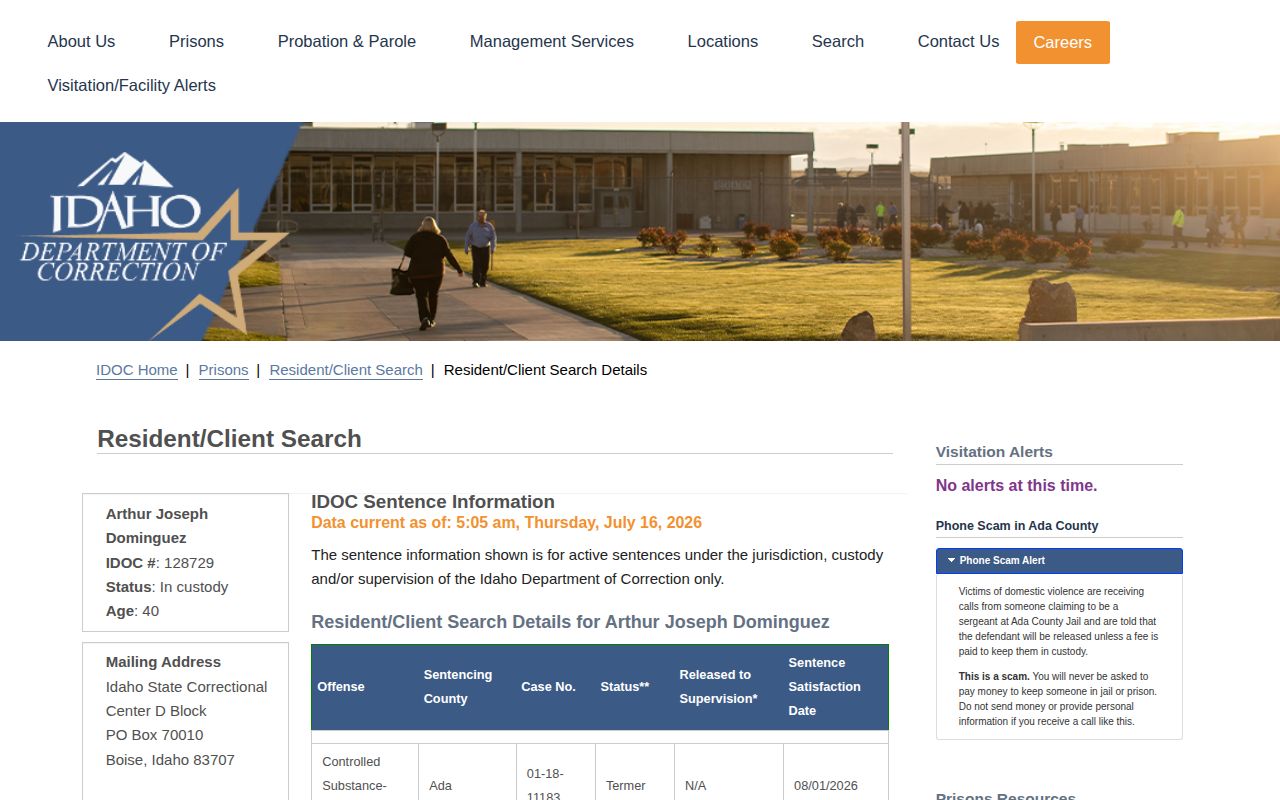
The combined fields show why a Butte County release date must be read with sentence status and the matching case, not as an isolated date.
Butte County Scheduled Versus Actual
A Commission grant can produce a tentative parole date. The person still may need to finish required programs, secure approval of a parole plan, complete paperwork, and reach final release arrangements. Unforeseen events can alter or void the tentative date.
The Commission decision page warns that dates are tentative and that no incarcerated person will be released before the listed date. A public decision should therefore be paired with a later correction record.
If the date passes while IDOC still shows “In custody,” do not assign a cause. Contact IDOC or the Commission. The public record may not reveal a program issue, plan review, new hold, correction, or other lawful reason.
Butte County Unified Sentence Rule
Idaho Code section 19-2513 directs the court to state a minimum fixed period and a later indeterminate period as one unified sentence. The fixed part is the controlling minimum before parole eligibility, subject to narrow statutory exceptions. The Commission may consider parole during the indeterminate part under section 20-223.
This structure differs from a simple percentage formula. Idaho does not have a general rule that every person serves 85 percent or earns an automatic 15-percent reduction. Applying such a shortcut to a Butte County case would ignore the judgment and Idaho's actual date labels.
Reports about release at 150 percent of a fixed term are also not a rule that each person must serve that amount. The Commission explains that an older statutory reporting benchmark changed, though agencies retained a measure for comparison. Performance data cannot replace a person's judgment.
Butte County Exceptional Credit
Idaho Code section 20-101D allows exceptional meritorious sentence reduction in narrow circumstances involving extraordinary heroism or outstanding service, such as saving a life or preventing major loss under the statutory conditions. It is not routine good time.
The implementing rule states that such credit is not a right or entitlement and can be withdrawn. A general estimate should never assume this rare reduction. Ask IDOC for the current sentence calculation if a claimed credit materially affects the expected date.
County jail credit is a different issue. Use the Butte court judgment and credited time, then ask the sheriff for the completed release calculation. Do not import IDOC parole rules into a local jail term that IDOC does not control.
Note: Idaho's fixed sentence portion, exceptional credit, and county jail credit are distinct concepts that must be traced to their own records.
Changes to Butte County Release Dates
A public date can move for many lawful reasons. The record should identify the reason before any conclusion is stated.
| Change | Where to check |
|---|---|
| Concurrent or consecutive sentences | Judgment and each IDOC sentence line |
| Amended judgment or jail credit | iCourt docket and certified court order |
| Parole action or revocation | Commission notice and later IDOC status |
| Program or parole-plan completion | IDOC or Commission confirmation |
| Disciplinary event or calculation correction | Current IDOC sentence calculation |
| Detainer, warrant, or another hold | Holding and receiving agencies |
| Escape or absconding time | Commission, court, and correction records |
IDOC says its public search is updated daily but warns that status, location, and scheduled termination can change quickly. Save the access date and recheck close to the expected event. A new court order or overlapping case may not be obvious in the first result viewed.
Idaho's Four Release Date Concepts
The four-part Idaho sequence is the distinctive answer to a projected-date question. Parole Eligibility Date opens the possible decision window. A tentative date follows a Commission grant. Released to Supervision documents community placement. Sentence Satisfaction Date marks the calculated full-term endpoint.
These points can fall far apart. They may also change as sentences, Commission decisions, plans, and calculations change. Exceptional meritorious credit does not turn the sequence into routine good time, and the fixed term cannot be replaced by an 85-percent estimate.
For a Butte County state case, keep the IDOC number and court case number together. Read the judgment first, then IDOC fields, then the Commission notice, and finally the post-date status. That sequence preserves the difference between expectation and fact.
The official Commission parole FAQ explains eligibility and tentative dates. When the result must support a legal process, request the current calculation instead of relying on a saved screen.
Confirm Butte County Actual Release
After the expected date, seek evidence from the agency that completed the event. For a state prisoner, “In community” plus Released to Supervision is stronger proof than the prior tentative date. For full completion, read the Discharged status and satisfaction information together.
For Butte County Jail, ask whether the person returned to the community or went to another custodian. Obtain the release time, authority, and destination. A roster disappearance alone cannot distinguish release from transfer.
A VINELink alert may provide prompt notice, but it remains a notification rather than a certified historical record. The Butte County VINELink release check explains how to register and confirm an alert. For a documented state calculation, use the IDOC records request process.