
Butte Cases in IDOC Custody
The Idaho Department of Correction operates a statewide prison and community-supervision system. A Butte County felony judgment committed to IDOC does not imply placement at a local prison. IDOC may assign the person to an institution or contracted placement elsewhere in Idaho, and the public record can still connect the sentence to Butte County.
The official Resident/Client Search reflects that broad scope. “Resident” refers to a person in prison custody. “Client” includes a person supervised in the community. It is not a complete archive of everyone ever booked at Butte County Jail, and a county defendant who never entered IDOC jurisdiction may not appear.
If the Butte sheriff reports a transfer to IDOC, obtain the destination and transfer time from the county release entry. Then use the state search for the later custody record. The county sheet documents the handoff. The IDOC result documents the state episode.
Search a Butte IDOC Record
An IDOC number is the least ambiguous search key. When it is unknown, use surname and given name, try known variants, and compare middle name and birth year. A shared name alone cannot establish identity.
- Open the IDOC Resident/Client Search and enter the IDOC number or a name.
- Review the results for IDOC number, full name, birth year, and public status.
- Open the detail record for the most likely match.
- Confirm “Sentencing County: Butte” or match the Butte case number.
- Read every active sentence, not only the first offense listed.
- Record the status and access date, then recheck near an expected change.
Concurrent and consecutive sentences can carry different dates. A record tied to another county may still belong to the same person, but it should not be called the Butte sentence without the case match. The iCourt case record supplies the judgment and later amendments that explain the legal basis.
The broader Butte County release search covers the sheriff and court paths for a person whose record never reached IDOC.
Read Idaho Correction Status Fields
The result and detail screens use terms that answer different questions. The results table can show dated “Discharged” entries beside “In custody,” “In community,” and “Active Bench Warrant.” The detail may add location, offense, sentence status, and several dates. Not every field appears for every person.
| Field or status | What it means |
|---|---|
| In custody | IDOC reports current prison custody under the record |
| In community | The person is outside prison under the displayed state status, usually supervised |
| Active Bench Warrant | A supervision matter remains unresolved; physical location is not established |
| Released to Supervision | Most recent placement on supervision by the court or Commission |
| Sentence Satisfaction Date | Calculated full-term endpoint for a sentence |
| Discharged | IDOC's displayed jurisdiction ended on the stated date |
Released to Supervision is not discharge. A parole client can live in the community while serving the rest of the state sentence. Likewise, a discharge from IDOC does not prove that no new county, federal, or immigration matter exists.
See Butte Release Detail Fields
The official IDOC detail example demonstrates how public status, Released to Supervision, sentence information, county, and case fields can appear on one record.
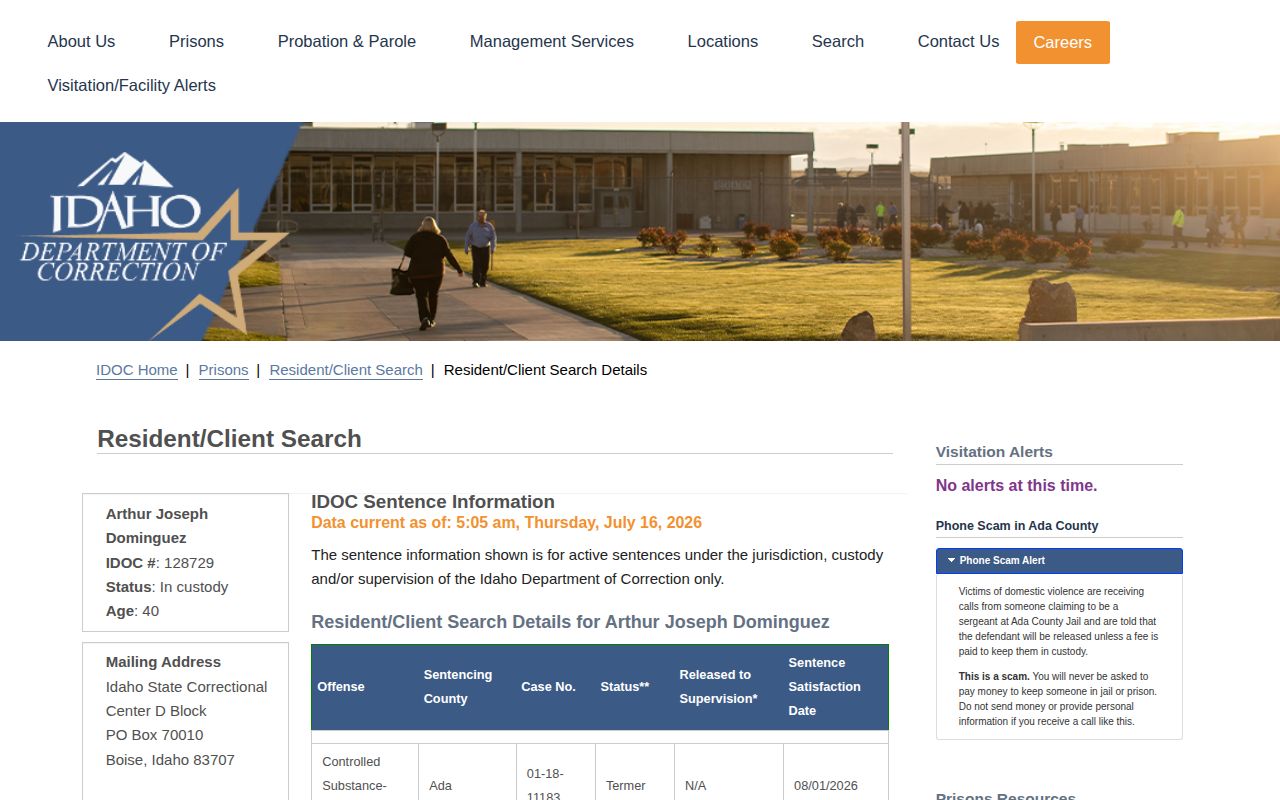
The screen shows why a date must be read beside the status and matching sentence. A date taken out of context can confuse parole eligibility, community placement, full-term satisfaction, and final discharge.
For a Butte conviction, verify the sentencing county or case number before relying on the displayed dates. If several active sentences appear, obtain the judgment for each and ask IDOC for a current calculation when exact legal timing matters.
Idaho Prison Release Date Terms
Idaho does not display one universal “release date.” Parole Eligibility Date is the earliest point when parole may be considered under the sentence. It is not a promised departure. A tentative parole date follows a Commission grant but remains subject to programming, an approved parole plan, papers, and final arrangements.
Sentence Satisfaction Date is the calculated full-term endpoint. It may remain years after release to parole because parole serves the sentence in the community. The later “In community” status and Released to Supervision date are stronger public confirmation that prison placement ended than the earlier tentative date.
Idaho also does not support a generic 85-percent shortcut. Idaho Code section 19-2513 creates a unified sentence with a fixed minimum part followed by an indeterminate part. Exceptional meritorious reduction under section 20-101D is narrow and is not routine good time.
Confirm an IDOC Community Release
A parole decision is supporting evidence, not the completed event. Match the IDOC number on the Commission notice of action, note any tentative date, and then return to IDOC on or after that date.
- Confirm that the result changed from “In custody” when appropriate.
- Look for “In community” and a sentence status of parole.
- Read the Released to Supervision date.
- Check for another active sentence or warrant.
- Request clarification if the public fields conflict.
VINELink can provide notice of a custody change but is not a certified historical record. For an official account of the state event, request the release-to-supervision entry. For the court authority, obtain the judgment or amended order from the court custodian.
Note: Community status confirms no current IDOC prison placement under the displayed record, but it commonly means IDOC supervision continues.
Request Butte IDOC Release Records
When the public search is not enough, use IDOC Records Information. State exactly what is needed: a release-to-supervision entry, discharge date, current sentence calculation, transfer history, or releasable photograph. Include the IDOC number, full name, Butte case number, and the relevant custody period.
A focused request is easier to route than a demand for every document. Ask for an electronic copy when practical and invite redaction of protected information rather than withholding the releasable remainder. Correctional security, victim, medical, and other lawful limits can apply.
Commission minutes or retained decision material follow the Commission public-information route. Filed judgments belong to the court clerk. The Butte sheriff holds the local booking and transfer sheet. Each custodian can verify only the record it created.
Separate IDOC From Other Custody
A disappearance from the Butte jail is not enough to choose IDOC. Ask the sheriff whether the event was community release or transfer. If another county received the person, contact that jail. If USMS or BOP received the person, use federal channels. If ICE assumed custody, use the ICE locator and obtain the destination promptly.
| Custody question | Correct source |
|---|---|
| Butte booking exit or transfer | Butte County Sheriff release entry |
| Idaho prison or state supervision | IDOC Resident/Client Search |
| Legal sentence and amendments | iCourt and the filing court |
| Federal prison sentence | BOP Inmate Locator |
| Immigration detention | ICE Online Detainee Locator |
This division prevents a state prison discharge from being mistaken for a county release, or a county transfer from being called freedom. The originating and receiving records should form one continuous chain.